 Add to Chrome
 Add to Firefox
 Add to Edge
MinT: Managed Infrastructure for Training and Serving Millions of LLMs
May 13, 2026
We present MindLab Toolkit (MinT), a managed infrastructure system for Low-Rank Adaptation (LoRA) post-training and online serving. MinT targets a setting where many trained policies are produced over a small number of expensive base-model deployments. Instead of materializing each policy as a merged full checkpoint, MinT keeps the base model resident and moves exported LoRA adapter revisions through rollout, update, export, evaluation, serving, and rollback, hiding distributed training, serving, scheduling, and data movement behind a service interface. MinT scales this path along three axes. Scale Up extends LoRA RL to frontier-scale dense and MoE architectures, including MLA and DSA attention paths, with training and serving validated beyond 1T total parameters. Scale Down moves only the exported LoRA adapter, which can be under 1% of base-model size in rank-1 settings; adapter-only handoff reduces the measured step by 18.3x on a 4B dense model and 2.85x on a 30B MoE, while concurrent multi-policy GRPO shortens wall time by 1.77x and 1.45x without raising peak memory. Scale Out separates durable policy addressability from CPU/GPU working sets: a tensor-parallel deployment supports 10^6-scale addressable catalogs (measured single-engine sweeps through 100K) and thousand-adapter active waves at cluster scale, with cold loading treated as scheduled service work and packed MoE LoRA tensors improving live engine loading by 8.5-8.7x. MinT thus manages million-scale LoRA policy catalogs while training and serving selected adapter revisions over shared 1T-class base models.

$δ$-mem: Efficient Online Memory for Large Language Models
May 12, 2026Large language models increasingly need to accumulate and reuse historical information in long-term assistants and agent systems. Simply expanding the context window is costly and often fails to ensure effective context utilization. We propose $δ$-mem, a lightweight memory mechanism that augments a frozen full-attention backbone with a compact online state of associative memory. $δ$-mem compresses past information into a fixed-size state matrix updated by delta-rule learning, and uses its readout to generate low-rank corrections to the backbone's attention computation during generation. With only an $8\times8$ online memory state, $δ$-mem improves the average score to $1.10\times$ that of the frozen backbone and $1.15\times$ that of the strongest non-$δ$-mem memory baseline. It achieves larger gains on memory-heavy benchmarks, reaching $1.31\times$ on MemoryAgentBench and $1.20\times$ on LoCoMo, while largely preserving general capabilities. These results show that effective memory can be realized through a compact online state directly coupled with attention computation, without full fine-tuning, backbone replacement, or explicit context extension.
Gen-Searcher: Reinforcing Agentic Search for Image Generation
Mar 30, 2026Recent image generation models have shown strong capabilities in generating high-fidelity and photorealistic images. However, they are fundamentally constrained by frozen internal knowledge, thus often failing on real-world scenarios that are knowledge-intensive or require up-to-date information. In this paper, we present Gen-Searcher, as the first attempt to train a search-augmented image generation agent, which performs multi-hop reasoning and search to collect the textual knowledge and reference images needed for grounded generation. To achieve this, we construct a tailored data pipeline and curate two high-quality datasets, Gen-Searcher-SFT-10k and Gen-Searcher-RL-6k, containing diverse search-intensive prompts and corresponding ground-truth synthesis images. We further introduce KnowGen, a comprehensive benchmark that explicitly requires search-grounded external knowledge for image generation and evaluates models from multiple dimensions. Based on these resources, we train Gen-Searcher with SFT followed by agentic reinforcement learning with dual reward feedback, which combines text-based and image-based rewards to provide more stable and informative learning signals for GRPO training. Experiments show that Gen-Searcher brings substantial gains, improving Qwen-Image by around 16 points on KnowGen and 15 points on WISE. We hope this work can serve as an open foundation for search agents in image generation, and we fully open-source our data, models, and code.
Exploring Reasoning Reward Model for Agents
Jan 29, 2026Agentic Reinforcement Learning (Agentic RL) has achieved notable success in enabling agents to perform complex reasoning and tool use. However, most methods still relies on sparse outcome-based reward for training. Such feedback fails to differentiate intermediate reasoning quality, leading to suboptimal training results. In this paper, we introduce Agent Reasoning Reward Model (Agent-RRM), a multi-faceted reward model that produces structured feedback for agentic trajectories, including (1) an explicit reasoning trace , (2) a focused critique that provides refinement guidance by highlighting reasoning flaws, and (3) an overall score that evaluates process performance. Leveraging these signals, we systematically investigate three integration strategies: Reagent-C (text-augmented refinement), Reagent-R (reward-augmented guidance), and Reagent-U (unified feedback integration). Extensive evaluations across 12 diverse benchmarks demonstrate that Reagent-U yields substantial performance leaps, achieving 43.7% on GAIA and 46.2% on WebWalkerQA, validating the effectiveness of our reasoning reward model and training schemes. Code, models, and datasets are all released to facilitate future research.
SophiaVL-R1: Reinforcing MLLMs Reasoning with Thinking Reward
May 22, 2025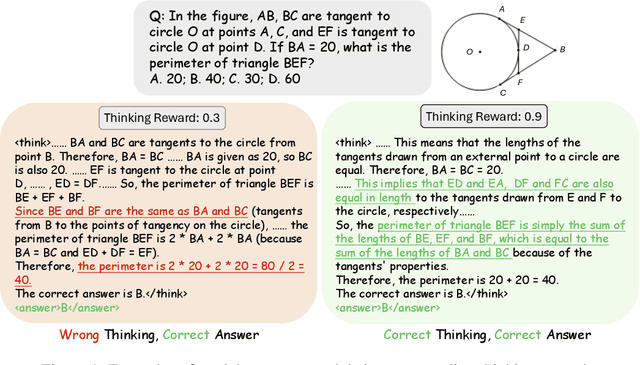
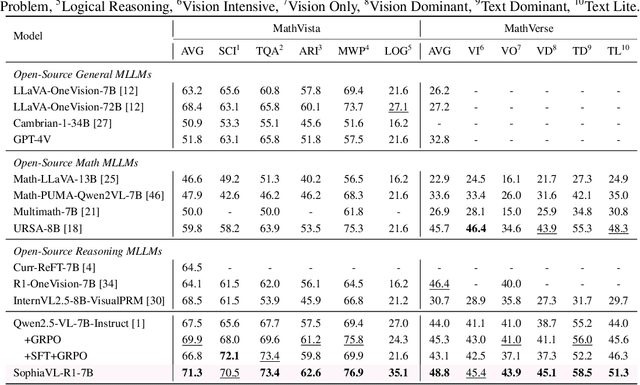
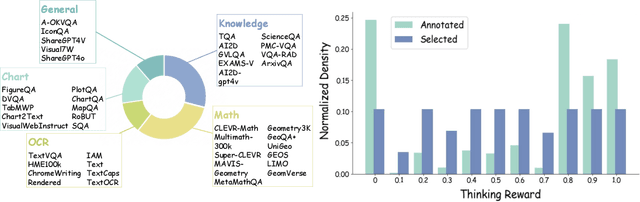
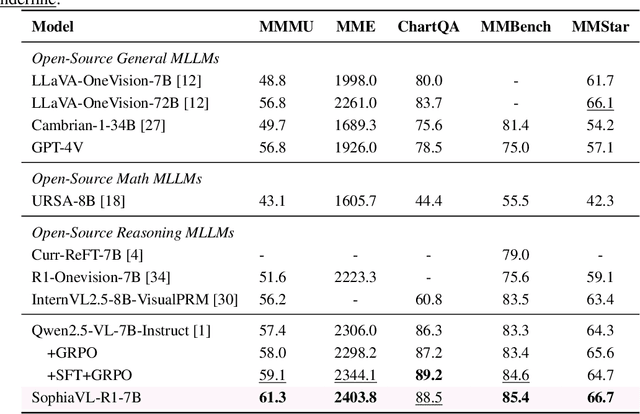
Recent advances have shown success in eliciting strong reasoning abilities in multimodal large language models (MLLMs) through rule-based reinforcement learning (RL) with outcome rewards. However, this paradigm typically lacks supervision over the thinking process leading to the final outcome.As a result, the model may learn sub-optimal reasoning strategies, which can hinder its generalization ability. In light of this, we propose SophiaVL-R1, as an attempt to add reward signals for the thinking process in this paradigm. To achieve this, we first train a thinking reward model that evaluates the quality of the entire thinking process. Given that the thinking reward may be unreliable for certain samples due to reward hacking, we propose the Trust-GRPO method, which assigns a trustworthiness weight to the thinking reward during training. This weight is computed based on the thinking reward comparison of responses leading to correct answers versus incorrect answers, helping to mitigate the impact of potentially unreliable thinking rewards. Moreover, we design an annealing training strategy that gradually reduces the thinking reward over time, allowing the model to rely more on the accurate rule-based outcome reward in later training stages. Experiments show that our SophiaVL-R1 surpasses a series of reasoning MLLMs on various benchmarks (e.g., MathVisita, MMMU), demonstrating strong reasoning and generalization capabilities. Notably, our SophiaVL-R1-7B even outperforms LLaVA-OneVision-72B on most benchmarks, despite the latter having 10 times more parameters. All code, models, and datasets are made publicly available at https://github.com/kxfan2002/SophiaVL-R1.
Diffusion Autoencoders for Few-shot Image Generation in Hyperbolic Space
Nov 27, 2024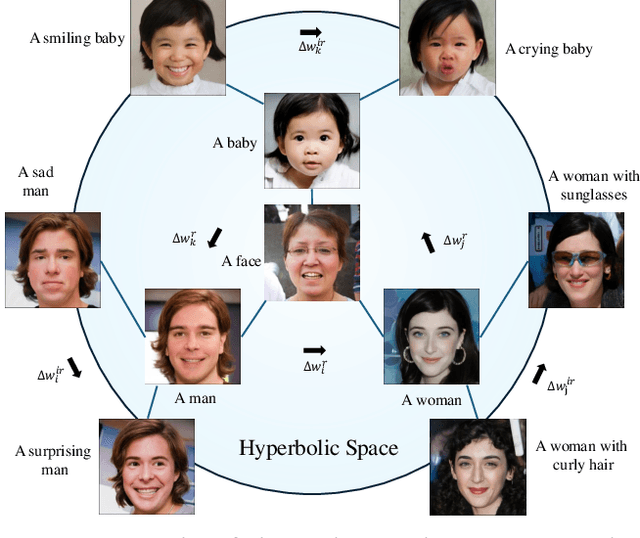
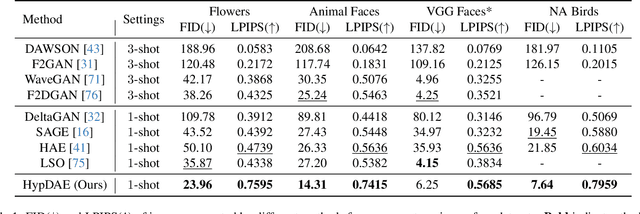
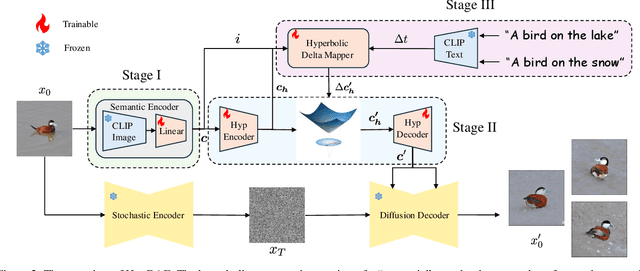
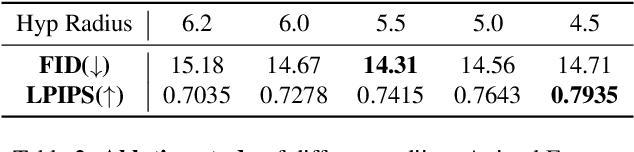
Few-shot image generation aims to generate diverse and high-quality images for an unseen class given only a few examples in that class. However, existing methods often suffer from a trade-off between image quality and diversity while offering limited control over the attributes of newly generated images. In this work, we propose Hyperbolic Diffusion Autoencoders (HypDAE), a novel approach that operates in hyperbolic space to capture hierarchical relationships among images and texts from seen categories. By leveraging pre-trained foundation models, HypDAE generates diverse new images for unseen categories with exceptional quality by varying semantic codes or guided by textual instructions. Most importantly, the hyperbolic representation introduces an additional degree of control over semantic diversity through the adjustment of radii within the hyperbolic disk. Extensive experiments and visualizations demonstrate that HypDAE significantly outperforms prior methods by achieving a superior balance between quality and diversity with limited data and offers a highly controllable and interpretable generation process.